


His Eminence Rinchen Dorjee Rinpoche’s Puja Teachings – September 6, 2026

On September 6th, 2026, Founding Abbot Guru His Eminence Rinchen Dorjee Rinpoche presided over the ‘Indiscriminate Amitabha Puja for Transferring Consciousness of the Drikung Kagyu Lineage’ at the Glorious Jewel Buddhist Monastery of Rinchen Dorjee Rinpoche for the second time, to help sentient beings transcend the reincarnation’s sea of suffering through the incomparably wondrous Vajra Dharma.
‘The Great Amitabha Dharma for Transferring Consciousness’ is an extremely incomparably wondrous earth terma of the Drikung Kagyu lineage. The person presiding over the Dharma must have attained the fruition level of an Rinpoche, and with a deep and vast foundation in Exoteric Buddhism; have completed ‘The Four Extraordinary Foundations of Vajrayana Ngondro ’; have undergone retreat to recite over one million chants of the ‘Amitabha heart mantra’ and reached attainment with the yidam; achieved the attainment of the Mahamudra chanding (Puja Teachings Index 06), Simplicity Yoga (Niṣprapañca-yoga). In addition, he must have attained ‘the Phowa,’ which can transfer the consciousness of the deceased to the Pure Land. Only then can the practitioner preside over this Dharma. His Holiness the Drikung Kyabgon Chetsang transmitted the four Vajrayana empowerments to Rinpoche alone. ‘Indiscriminate’means that there are no grand donors in the puja, and merit is not measured through wealth or social status, all sentient beings who possess the fate to attend the puja may receive the blessings and protections of the Buddhas and Bodhisattvas equally.
Through his great compassion (maitrī and karuṇā) and the merit and capability of attaining a fruition level through his own cultivation, Rinpoche has received the constant protection and blessing of all the Buddhas and Bodhisattvas, nagas, devas, and Dharma protectors. Since 2005, he has presided over the Indiscriminate Amitabha Puja for Transferring Consciousness in Taiwan for sixteen consecutive years, with over 20,000 attendees at each puja. He has also traveled to Japan numerous times to hold this incomparably wondrous puja. Since the completion and consecration of the Glorious Jewel Buddhist Monastery of Rinchen Dorjee Rinpoche, Rinpoche has held Great Indiscriminate Puja for Transferring Consciousness at the Monastery every year, liberating countless sentient beings with a fate to receive his help. The merits are extraordinarily profound and inconceivable.
On the day of the puja, as Rinpoche stepped onto the mandala and prostrated to the Buddhas and Bodhisattvas, all the sacred statues on the mandala instantly radiated brightness, demonstrating Rinpoche’s compassionate (maitrī and karuṇā) power to liberate sentient beings was perfectly attained with the Buddhas and Bodhisattvas. During the puja, Rinpoche taught that a Vajrayana Puja for Transferring Consciousness is incomparably wondrous and extremely rare. He earnestly urged everyone to cherish the fate and good fortune that had enabled them to attend a Vajrayana puja in this lifetime, to revere the guru and the Three Jewels, to resolve to take refuge in a meritorious guru, to adopt a vegetarian diet, refrain from killing, learn the Buddha Dharma, and to make a vow to be reborn in the Pure Land, therefore accumulating the good fortune and merit necessary for rebirth in the Pure Land.
Even before the puja began, layers of auspicious clouds billowed in the clear sky, and two parallel rainbows appeared on the horizon. Throughout this time, birdsong continued without cease as flocks of birds gracefully swept across the sky. As Rinpoche performed the Dharma, the earth shook repeatedly, a miraculous fragrance permeated the air, and warmth circulated through the bodies of those present. These phenomena revealed that the guru had attained accomplishment in the practice of the yidam and that all the Buddhas and Bodhisattvas had come to bestow their blessings.
As Rinpoche performed the Dharma and recited Amitabha’s heart mantra, his sacred body radiated brilliant light, and golden rays illuminated all sentient beings. This revealed the incomparably wondrous state in which Rinpoche was in complete attainment and indivisible union with the yidam, as well as his boundless heart of karuṇa, wishing that all sentient beings could attain liberation.
When Rinpoche began to transfer consciousness, suffering sentient beings awaiting deliverance surged in from all directions. The venue was immediately shrouded in gloom and pervaded by a penetrating chill, while the enormous victory banners suspended from the roof swayed from time to time. As the Dharma drew to its perfect completion, the earth trembled, and the entire venue became warm and radiant. Rinpoche and the mandala emitted dazzling golden light, while the power of his great compassionate(maitrī and karuṇā) vows pervaded the entire Dharma realm, bringing physical and mental ease to all sentient beings.
After the puja was perfectly completed, incomparably wondrous auspicious signs appeared in the clouds. The clouds resembled Amitabha Buddha seated on a lotus throne, surrounded by a seven-colored halo in the back, personally arriving to bestow blessings and guide sentient beings. The Buddhas and Bodhisattvas could also be seen surrounding him. At that moment, a gentle, nectar-like rain descended from the sky, touching people without making them wet. From the beginning of the puja until its perfect completion, the entire Monastery grounds remained suffused with a lingering fragrance that did not dissipate. All who perceived it experienced purity of body and mind and responded with admiration and rejoicing. These incomparably wondrous auspicious signs were as though the Buddhas and Bodhisattvas had personally arrived to praise Rinpoche’s incomparably wondrous and perfect attainments in cultivation, as well as his vast karuṇā vows and immeasurable merits in benefiting sentient beings.
On September 6th, 2026, His Eminence Rinchen Dorjee Rinpoche held the‘Great Indiscriminate Amitabha Puja for Transferring Consciousness of the Drikung Kagyu Lineage’for the second time at the Glorious Jewel Buddhist Monastery. On the preceding day (September 5), Rinpoche had already practiced Amitabha at the Monastery for the entire day. On the day of the puja at 9:24 AM, with the welcoming procession of dhavja, patākā, monastics, Eight Offering Girls, the jeweled sitātapatra, musical instruments, and incense leading the way, Rinpoche walked across the flower petal-laden white carpet adorned by the Eight Auspicious Symbols and entered the Mahavira Hall of the Monastery. Amid solemn and majestic music, all attendees stood respectfully with palms joined to welcome Rinpoche as he ascended the Dharma throne.
Upon stepping onto the mandala, Rinpoche prostrated to all Buddhas and Bodhisattvas, lit lamps as offerings to the Buddha, then ascended the Dharma throne. Afterward, Rinpoche lit the main lamps presented by attendants for the offering tables on either side, and instructed the monastic disciple and disciples with vajras and bells to go up to the mandala to light lamps as an offering to the Buddha. Rinpoche then instructed the monastic disciple to lead the assembly in reciting the Refuge Motivation Prayer, the Four Immeasurable Hearts, and the Sevenfold Offering Prayer. Then, Rinpoche bestowed precious Dharma teachings:
Today, I will perform the Amitabha Dharma for Transferring Consciousness. In the past, I used to hold ‘the Great Indiscriminate Amitabha Puja for Transferring Consciousness’ in Taipei every year, with more than 20,000 people attending each time for sixteen consecutive years. Later, with the construction of the Monastery underway and the outbreak of the COVID-19 pandemic, the puja was suspended. Organizing a large-scale, great puja for more than 20,000 people required a considerable amount of funding. Moreover, I don’t accept offerings for the pujas I held, nor do we have any major donors. Therefore, all the expenses for these great pujas were borne by all the disciples. In the past, each Great Amitabha Puja cost more than NT$20 million to organize. After holding it for sixteen years, I felt that those who had the fate to receive consciousness-transference had already been transferred. As for those without a fate, even if I wished to help transfer their consciousnesses, there was nothing I could do. I also came to feel that, despite sixteen years of holding these pujas, the believers who attended did not continue to learn or practice the Buddha Dharma. They were only making use of the Buddha Dharma, hoping to live better lives. So, I decided to stop holding this great puja for 20,000 people.
Since we stopped holding the great puja for more than 20,000 people, no one in Taiwan has been able to hold a puja for transferring consciousness attended by more than 20,000 people so far. After the Monastery was completed, I began holding the Amitabha Puja of Transferring Consciousness once a year. Many people think that they have attended the puja once, and the transference has been performed; everything has been taken care of. In fact, we have committed a great deal of evil karma throughout lifetime after lifetime; there are many family members and parents we have had lifetime after lifetime as well, and some may not yet have accumulated sufficient virtuous fate to receive consciousness-transference. Therefore, as their descendants, we must continue to practice the Buddha Dharma and diligently advance in our practice, so that those with whom we have formed bonds of kindness or resentment over countless lifetimes may receive consciousness-transference.
Many people think that simply reciting sutras is enough to perform consciousness-transference. Based on my own experience in practice, it is impossible to transfer consciousness through sutra recitation in no more than forty-nine days. Furthermore, those reciting the sutras must be pure and expect nothing in return. It is recorded in sutras in ancient China that the lineage which can truly hold and perform the Amitabha Puja of Transferring Consciousness only exists in Tibet, no such lineage exists in ancient China. You have participated in ‘the Precious Penitential Liturgy of Emperor of Liang ’; this Penitential Liturgy is also introduced in Exoteric Buddhism. In this Penitential Liturgy, it is said that one of Emperor Wu of Liang’s consorts harbored intense hatred during her lifetime. After she died, she fell into the Animal Realm and was reborn as a giant python. Although she had followed Emperor Wu of Liang in a vegetarian diet, paying homage to the Buddha, and reciting sutras, she nevertheless fell into the Animal Realm because she had not practiced. She appeared to Emperor Wu of Liang in a dream, seeking liberation from the reincarnation’s sea of suffering. Emperor Wu of Liang, therefore, implored Master Bao Zhi, the Imperial Preceptor, for help. Master Bao Zhi gathered approximately one thousand monastics and compiled the Precious Penitential Liturgy of Emperor of Liang. They continuously recited the text day after day. In the end, however, Emperor Wu’s consort merely left the Animal Realm and was reborn in the Heaven Realm; she did not reach Amitabha’s Pure Land.
Many people learning Buddhism think that going to Amitabha Buddha’s place is very simple, as long as they recite a few lines every day or have attended a puja, they will be able to go there. If you have read the Five Sutras of the Pure Land School, you would know that going to Amitabha Buddha’s place is not something you can achieve simply because you wish to go. Nor can you expect to be reborn there simply by paying a group of people to recite sutras for you after you die. According to the Five Sutras of the Pure Land Buddhism taught by Shakyamuni Buddha, there are conditions that must be fulfilled in order to go to Amitabha’s place, and none of you have fulfilled those conditions. Therefore, I perform this Dharma today is not to let you live a comfortable life in the future.
As a practitioner, every thought we have should be wishing sentient beings to be liberated from the reincarnation’s sea of suffering. You have the fate to attend this puja today, it is only for the purpose of helping those sentient beings with whom you have formed bonds of kindness or resentment in the past to leave the reincarnation’s sea of suffering, so that they may have the opportunity to be reborn in a virtuous realm or in Amitabha’s Pure Land. This is a Vajrayana Dharma, not a sutra in Exoteric Buddhism. Therefore, one who performs this Dharma must have achieved attainment in Vajrayana before being qualified to perform it.
For the past sixteen years, I have performed the Dharma for Transferring Consciousness for more than 20,000 people every year. Never have I suffered from poor health, a shortened lifespan, or any problems as a result of performing this Dharma of consciousness-transference. It proves that this puja I held can truly benefit many people and help all sentient beings be liberated from the reincarnation’s sea of suffering.
As for those of you who can attend the puja today, basically, you must have planted some roots of virtue in past lives, or perhaps in this life, to have this opportunity to attend this puja. More than a month ago, I opened registration to many believers, yet some who had registered suddenly tested positive and could not come. Even today, two people made it all the way to the entrance but began feeling unwell and did not attend.
This shows that attending such an incomparably wondrous puja is not something you can make it to just because you want to. Nor can you attend simply because you say you want to help sentient beings. Without the fates accumulated over past lifetimes and without reverence for the Buddha Dharma, even if you make it all the way to the entrance, the Dharma Protectors will not let you in.
For those of you who are not my refuge disciples and are still uncertain about the path, hoping only to have a comfortable life, I hope that after attending today’s puja, you will do two things. First, become vegetarian. Second, the sooner you take refuge in Buddhism and begin learning the Dharma, the more it will certainly benefit you in this life and in future lives, it will do you no harm. Many people say that because they are laypeople, they have many things keeping them busy. But I am a lay practitioner too, and I have far more things to deal with than you do.
Now, I will start performing the Amitabha Dharma for Transferring Consciousness. Those attending the puja should settle their minds a little. Do not think too much, and do not hope that Amitabha Buddha will do something for you. Do not think about any of that. Just think of the people you wish to help; that is enough. If you are hoping that Amitabha Buddha will grant you a comfortable life, Amitabha Buddha never promised anything like that. In the Amitabha Sutra, Amitabha Buddha made only one promise: before sentient beings reach the end of their lives, virtuous men and women who must have no lack of good fortune, merits, and fates can attain rebirth in the Pure Land if they make vows to implore rebirth there. What does ‘no lack’ mean? It means that you have to do it every day. It does not mean coming to the puja today, doing nothing tomorrow, doing nothing the day after, and then waiting until next year to see whether Rinpoche is holding another puja so that you can come again. That is merely participating, it is not practice. Don’t think you’re somehow so great or that you’ve started to practice.
If we wish to go to Amitabha Buddha’s Pure Land, then we must be able to accomplish this sentence in the Amitabha Sutra. In addition, we need to cultivate the Three Sources of Felicity of the Pure Land Sect. This good fortune is not for changing your poverty or changing the things you do not want. Rather, it is to let you, in this lifetime, to be certain of going to Amitābha Buddha’s Pure Land. Going to Amitabha Buddha’s Pure Land is not a matter of being summoned and immediately arriving, or merely saying it and immediately arriving. It is only that the power of Amitabha Buddha’s original vows, the conditions are a bit better than those of the pure lands of other Buddhas.
What does ‘a bit better’mean? In the Pure Lands of any Buddha, one can’t be reborn carrying karma, no matter it is virtuous karma or evil karma, none of it can be brought. Amitābha Buddha’s Pure Land, one can be reborn with karma, this karma is the virtuous one, not the evil one. This means that in this lifetime, if all the evil karma has not been repaid and cleared, one can’t go there; one can only bring virtuous karma there. In other pure lands of Buddhas, not even virtuous karma can be brought along; one must be completely pure and clean, being in clarity and without confusion, to be reborn there. Therefore, Amitabha Buddha’s Pure Land is relatively more convenient. Second, because Bodhisattva Avalokiteshvara is the disciple of Amitabha Buddha, and almost every one of us has recited Bodhisattva Avalokiteshvara’s name. Therefore, if you are reverent toward Bodhisattva Avalokiteshvara, practice in accordance with the Dharma, don’t seek worldly matters, and seek only to go to the Pure Land, Bodhisattva Avalokiteshvara will definitely help you go there. Therefore, today, in practicing this Dharma, first, it is to help your karmic creditors from accumulated past lives, as well as your parents from past lives, to be able to leave the Three Evil Realms, be born in the virtuous realms, and be reborn in Amitābha Buddha’s Pure Land. It is also to help you plant the fate that, in the future, you will have the opportunity to go to Amitābha Buddha’s Pure Land.
However, if you do not practice in this lifetime, you still will not go there. Unless you practice, unless you take refuge and continue to act in accordance with the Dharma. After I start to perform the Dharma, I hope everyone can remain quiet. Don’t look around or let your mind wander, wondering whether this is really the case. As I just mentioned, I was able to perform this Dharma for 20,000 people for sixteen years without anything happening, proving that I am very capable.
Rinpoche began to perform the Dharma and bestowed teachings during the liturgy:
What was recited just now was a praise of Amitabha Buddha’s merits, there are several sentences that I will briefly explain to everyone: By reciting the name, enabling to eliminate untimely death. Therefore, you don’t need to implore. If you continue reciting, the Buddhas and Bodhisattvas will help you in many matters. Of course, one needs to accomplish observing the five precepts, and so on. ‘If one holds it in mind, one can eliminate worldly disaster.’ As long as the thought arises in the mind, all worldly disasters will be eliminated for you.‘If one takes refuge, one naturally attains eternal joy.’ If you are able to take refuge, then you will be able to attain constant, eternal joy. This isn’t worldly joy; it is the joy of being freed from life and death, and there is no reincarnation.‘We, forever and always, be reverent and praise to you.’ It means that we constantly and continually respectfully prostrate, be reverent, and praise. By ‘constantly,’ I do not mean that we are continuously making prostrations, but rather that in our thoughts and intentions, we prostrate to you with reverence and praise. Do not think that Amitabha Buddha cannot fulfill your wishes or help you, and then stop practicing; that would be wrong. Neither the Buddhas and Bodhisattvas nor your guru can change your karmic retributions for you. If you want to change your own karmic retributions, the only way is to continuously practice the Dharma transmitted to you by your guru and the Buddha. If you keep practicing without giving up, you will definitely be able to change them.
Rinpoche continued to perform the Dharma and led the assembly in reciting the heart mantra of Amitabha Buddha for a long time. As Rinpoche recited the mantra, his sacred body radiated great light, golden radiance shone universally upon sentient beings, manifesting the incomparably wondrous state in which Rinpoche and the yidam were in complete accord, inseparable and non-dual, as well as his boundless compassion (maitrī and karuṇā ) wishing all sentient beings to receive liberation. During this time, Rinpoche continually gazed around the surroundings with compassionate (maitrī and karuṇā )eyes. The venue was filled with a wondrous fragrance, and the ground trembled repeatedly; the assembly accordingly felt a warm current arising from within their hearts. Some people present were moved to tears, and then felt their chakras vibrate and their entire bodies become warm. Rinpoche used a five-colored cord to connect himself with the yidam and continued performing the Dharma.
Next, the mandala offering was performed. Rinpoche wore the Gampopa Dharma crown, and monastic disciples and the Eight Offering Girls proceeded to the mandala offering on behalf of the assembly. Afterward, the Tsok offering (Puja Teachings Index 03), the song offering by the Eight Offering Girls, the tea offering, and the rice offering were performed. When the offerings were distributed, the assembly received a portion of the offerings blessed by Rinpoche, as well as the rare and incomparably wondrous and virtuous fate of partaking in the offerings together with the yidam and the guru during the puja.
When the volunteers were distributing the offerings from the mandala to those in attendance, waves of noise rose throughout the venue. Rinpoche berated: Why are you being so noisy? Can you keep your voices down? Every one of you is afraid of losing out and not receiving it. We didn’t take any money from you, so please do not be so nervous, all right? Keep your voices down. All of you, be quiet. Open the offerings, and everyone eat a little.
Rinpoche, deeply concerned for the suffering beings in the bardo and their urgent longing to be free from suffering, instructed the disciples of the Dharma Affairs Team to move more quickly and reminded them to pay attention to the tea offered on his Dharma table.
Rinpoche continued performing the Dharma and expounded the following teachings:
From this point onward, the liberation liturgy begins. What was the purpose of performing so many liturgies earlier? It is because the karmic hindrances of sentient beings are all very heavy, making it impossible for them to receive Amitabha Buddha’s guidance and reception. You must not misunderstand and think that simply by attending a puja and reciting a few lines of Amitabha Buddha’s name, one can receive Amitabha Buddha’s guidance and reception. Sentient beings cannot go there without the necessary good fortune, merit, and fate. It is just like the example I often give: if you want to go anywhere, you must prepare travel expenses. Without travel expenses, how can you go? It is not that simply saying you want to go means you can go. Even if you have enough money to buy a plane ticket, if you do not have money for a hotel or food, you will starve to death after you arrive! Therefore, everything that was done earlier was for the purpose of quickly giving good fortune to you and to those sentient beings who wish to be liberated. If we practice according to the methods of Exoteric Buddhism, it is very slow. But by using the methods of Vajrayana, through the guru’s own practice and his accord with the yidam, good fortune can be very quickly given to the sentient beings one wishes to help, increasing good fortune that enables those sentient beings to receive liberation.
Therefore, for all of you sitting below, no matter why you came here today, from my perspective and from the perspective of the Buddhas and Bodhisattvas, it is all to help liberate sentient beings who are wandering helplessly in the sea of suffering of saṃsāra. It is not to do anything for you who are still living. Do not think that after attending the puja, things will become better for you in the future, or that your health will improve after attending the puja. That may be possible, but it has nothing to do with today’s Dharma performance. Why might it be possible? It may be because you have eaten a great deal of meat, and the karma of many sentient beings is upon your body, causing your health to be poor. It may also be because you have been disrespectful toward your ancestors, and your ancestors have thoughts of hatred and resentment, causing your health to be poor and your circumstances to be unfavorable. This is why we often speak of filial piety and compliance; only when one is filial can things become harmonious and smooth. Therefore, if you feel that things have improved after attending the puja, in fact, this is temporary; it is not eternal. Do not think that because you attended the puja with great sincerity and respect, the Buddhas and Bodhisattvas compassionately(maitrī and karuṇā) caused you to become better today. Do not be superstitious, and do not treat the Buddha Dharma as if it were a tirthika (non-Buddhist) path, thinking that by following along and making a few prostrations, you can have everything, or that by placing an apple as an offering, everything will be given to you. If it were that easy, then we wouldn’t have to practice so many Dharmas.
Today, you see me performing many, but in fact, I already began performing the Dharma yesterday. If it is a grand puja of more than 20,000 people, I must enter retreat for three days and practice continuously, because I am afraid that my own good fortune may not be sufficient. In your words, this means that my power may not be enough. Therefore, I must accumulate enough power of practice to send these sentient beings to Amitabha Buddha’s side and allow Amitabha Buddha to make arrangements for them. They may not necessarily go to the Pure Land. If, throughout lifetime after lifetime, they have never formed a fate with Amitabha Buddha, then in this lifetime, after they are sent to Amitabha Buddha’s side, Amitabha Buddha may first let them be reborn in the Human Realm, or perhaps in the Heaven Realm, depending on whether they can cultivate to the point of reaching Amitabha Buddha’s Pure Land. If these deceased beings, while they were alive, had even slightly approached Amitabha Buddha, or had once taken refuge in Buddhism, then through the Dharma I performed, they will have the opportunity to go to Amitabha Buddha’s Pure Land. Therefore, I have always earnestly urged all of you to take refuge in Buddhism. It is not that the Buddhas and Bodhisattvas need disciples; rather, this is something that must be done.
It is just like when you want to study—don’t you have to register first? When you want to see a doctor, don’t you have to make an appointment? Yet you take the Buddhas and Bodhisattvas for granted to this extent, thinking that you can simply go whenever you want? Just now, when the offerings were being distributed, I could see that you were taking the Buddhas, Bodhisattvas, and me for granted. Were you afraid you would not get one? Did I charge you anything for the offerings that were just distributed? (The assembly replies: No.) Then why were you so anxious about it? You will eat anything, but the one thing you refuse to swallow is a loss. Even when attending a puja, you are still so greedy. If you did not receive an offering, then just accept it! And some of you thought you were being helpful: ‘They’re one short over here! Give this to me; I’ll pass it over for you.’My Buddhist Monastery does not charge any fees, so I can scold you. If I charged you, I would not dare to scold you. When I perform consciousness-transference, do you see any memorial tablets displayed here? There are none at all. I have put all of your name lists onto this disc. We should be a little more scientific and environmentally friendly.
Why do you have to write a name on a piece of paper? Because it lets you see that the money you paid is now represented by that piece of paper. How clever you are! Just because your money is represented by that piece of paper does not mean that once a name is written on it, the Buddhas and Bodhisattvas will liberate that deceased person. I have never seen anything like that written in the Dharma texts, nor have I seen it in the Buddhist sutras! If the Buddhist sutras said, ‘Pay some money, write down the person’s name, and put it up beside the altar. Once the Buddhas and Bodhisattvas know about it, they will help liberate that person,’ then I could do the same. But I have never seen such a thing written in the Buddhist sutras, nor is it written in any of the Dharma texts I use in my Vajrayana practice. This is not a method taught to me by the Buddhas and Bodhisattvas, so I absolutely will not do it. Do you see any blessing lamps here? (The assembly replies: No.) First, we should be environmentally conscious. Second, I do not encourage superstition. By lighting just one lamp, you can be blessed and protected for an entire year? Wouldn’t that be far too easy? Nowadays, the cheaper ones may cost NT2,000, while the more expensive ones may cost NT20,000. A main blessing lamp might cost NT100,000 or NT200,000—I don’t know. If paying NT$200,000 could really guarantee you peace and safety for an entire year, I would be the first to raise my hand and say to Amitabha Buddha, ‘Amitabha Buddha, I’ll give you one million dollars, and then I won’t have to practice.’There is no such thing, all right?
Taking this opportunity during the puja, I would also like to share some authentic Buddhist teachings with you. As for how things are done elsewhere, I will not comment. I perform the practice solely according to what is taught in the Buddhist sutras, what is stated in the Dharma texts, and what my guru taught me. This Dharma text was transmitted to me personally, one-on-one, by His Holiness more than twenty years ago. Afterward, he did not explain to me how to perform it. Yet here in Taiwan, within our Drikung Kagyu lineage, I am the only one who has been able to publicly perform consciousness-transference for ten or twenty thousand people at a time. Perhaps His Holiness saw that I had the fate to do this, perhaps I have a particularly deep fate with the Pure Land, and that was why he specially transmitted this practice to me. Learning this practice is not simply a matter of reciting the text from beginning to end, one must have progressed in the practice of the Vajrayana teachings, understood the practice of Phowa, and attained accomplishment before one can perform this practice. Today, you have the fate to attend this puja, so you should all cherish this opportunity. In this lifetime, you may not have many more opportunities to attend a puja like this one conducted by me. I am getting old too—I am already eighty years old. I do not know how many more years I will be able to continue doing this. As far as I know, I am not sure whether there is anyone else who can publicly conduct a consciousness-transference puja on such a large scale and for so many people, but at present, there may no longer be anyone else doing so in Taiwan.
Therefore, you must listen closely to my words today and change yourselves. For example, earlier when distributing the food offerings, such anxious and greedy expressions appeared on your faces, forming the character—greed. Before you arrived, we had already calculated how many packages of the food offerings we would distribute to you. Even if the volunteers miss you during distribution, it is your fate. In the future, when you attend my pujas, don’t worry, I am very fair. Take today’s lunch boxes that you all ordered as an example — I don’t touch them, I don’t handle them. Originally, if I were to place the order, I could earn a small handling fee, but I don’t even earn that money.
I hope that attendees of future pujas can implore Avalokiteshvara Bodhisattva to give you the opportunity to come ahead of time; otherwise, there will be many obstacles. For instance, before today’s puja, I told everyone to remind the believers that if they have registered, they should refrain from canceling at the last minute since there are many people on the wait list; there are still one hundred or so people on the wait list even today. Suddenly, eight people did not show up today and even refused to answer the phone. Do these kinds of people have any credibility?
I don’t charge any fees here, you can decide on your own whether or not you want to make an offering to the Monastery—it is up to you. Even if you don’t make any offerings, I won’t show any attitude. Roughly how much does each package of food offering cost me? (The disciple responsible replies: NT$230.) I am a very generous person—when presiding over pujas, I never calculate anything with you; for instance, I have not calculated anything regarding the mandala; everything costs money, for instance, these Dharma instruments are mine. Therefore, I hope that all attendees of this puja—since I don’t want anything it shows that I am very capable. I don’t use Buddha Dharma to invent some kind of cause for you to make donations to do things for compassion(maitrī and karuṇā) or charity—I don’t do any of that; instead, I simply follow the Buddhist sutras strictly to help you.
After attending the puja today, I hope that you can give some serious thought to whether you want to take refuge in Buddhism and learn the Buddha Dharma—don’t waste this life. After this life ends, no one knows whether one can return as a human being; even the Bodhisattvas can’t say for sure. No one comes back immediately as a human being after they die. Don’t think, ‘It’s okay, I’m busy, wait till I retire, and when my kids grow up, then I’ll practice.’ If I were a monk, and you said such words to me, I would say, ‘Virtuous men and women, virtuous men, how good of your aspirations; it’s okay, the Buddha and Bodhisattvas will wait for you.’ Yeah right! The Buddha and Bodhisattvas are never reborn or dead—they are eternal, but it is your karmic creditors and karmic forces that won’t wait! Therefore, think it over clearly—today, as an eighty-year-old man, I went through all the trouble to help you, asking for nothing in return—no money, no fame, and yet if you still behave so heartlessly and constantly exploit the Buddhas and Bodhisattvas, just you wait and see. You wait and see if I ever have the chance to hold another puja for you. Do not think that I am cursing you—the Buddhas, Bodhisattvas, and gurus do not curse anyone, but from my life experiences, not learning Buddhism will be your greatest loss—it’s even greater than losing an entire house.
Now I will begin to perform consciousness-transference, and I hope that all of you ladies and gentlemen can settle your hearts and think of the people who are still suffering and reincarnating within the Six Realms—do not think that you are suffering since you all have places to sleep in, food to eat, and clothes to wear; your conditions are already pretty good. We live in Taiwan, where, despite matters being quite chaotic, we are still better off than other places. Everyone must cherish the good fortune, not so that one can live better, but to cherish the good fortune which has given us the opportunity to learn Buddhism in this life. It is very difficult to learn Buddhism in other places—I’m not specifying which places, so don’t go fitting the descriptions yourself.
Rinpoche began performing the Dharma, and subsequently instructed the attendees to say the names of the deceased out loud. The attendees immediately said the names of the deceased whom they wanted to help. Rinpoche instructed: Louder. You all spoke so loudly earlier, and yet you speak so quietly now. Speak up—don’t be shy.
This latter sentence is very important because of the guru’s compassionate (maitrī and karuṇā) heart, and the Buddhas’, Bodhisattvas’, and Yidan’s compassionate (maitrī and karuṇā) heart, help these sentient beings through your sincerity, which is why I asked you to speak louder—don’t be so feeble and listless; everyone spoke so loudly and with such energy when the food offerings were being passed down. Recite the names of the deceased that you want to help three more times, and speak louder. (The assembly immediately recites the names of the deceased that they want to help three times.)
The latter sentence remarked: you want to help the deceased, whether they are in the Three Worlds and Six Realms, which include Hell, Hungry Ghost, Animal, Human, Asura, and Heaven—in an instance, they all merge into this list of the deceased. Therefore, what does it mean to practice Dharma? The Buddha, Bodhisattvas, and guru must give their merit and compassion (maitrī and karuṇā) to the sentient beings, as well as to those people who want their help. Normally, your voices are loud during fights; so are you pretending to be sincere or gentle? You must recite and call upon them with an earnest and fervent heart. Look at how earnest and fervent you were when fighting for the food offerings: ‘Over here, there’s one missing, come, come, come.’ And yet, you sound like mosquitoes when you recite the name of the deceased. There’s nothing to do since no one has taught you. The Dharma for consciousness-transference can’t be achieved just because I am capable; it also requires your earnest and fervent hearts; neither can be missing. Don’t be shy, because when so many people are calling out names, I can’t hear you; only the deceased can.
This sentence makes it clear that all beings from the Six Realms can come, but if you don’t call out their names. Try to recall the time when you were a child; whenever something painful occurred, you’d always call out for mom, right? Why, then, now faced with these deceased beings, can’t you call out loudly? Shy?Embarrassed? Apologetic? Devoid of energy? This shows you came for your own benefit today, which has nothing to do with the Dharma practice I mentioned. You fell for it! Many of you are here for the first time today and did not know that this is the case. Because I don’t receive any offerings, I am greater.
Say it out loud three more times. (The assembly immediately recites the names of the deceased they want to help three times.) Okay, they heard you, not me.
Rinpoche continued to practice the Dharma and instructed the assembly to stand up and clasp their palms. Then, Rinpoche compassionately(maitrī and karuṇā) instructed the assembly to recite along: Wandering in fear in the middle stage upon the Gates of Yama. Tortured by vexations and sufferings. Lingering in a desolate state. Pray that the power of compassion may save and protect us. (After reciting three times, Rinpoche instructed the assembly to bow in prostration to Rinpoche and the various Buddhas and Bodhisattvas before sitting down.)
While performing the Dharma, Rinpoche exhibited the furious Dharma appearance. When Rinpoche began practicing consciousness-transference, sentient beings who awaited consciousness transference fled from all directions, and the premise was suddenly filled with drafts of cold wind from the mandala, while the enormous dhavjas hanging from the roof moved from time to time. Some people put on their jackets but could still feel the waves of cold permeating them while infants cried. After consciousness-transference concluded, the premise became warm and bright, and only then did the assembly feel the temperature rise back while their bodies warmed up. Rinpoche and the various sacred statues of the mandala emitted a brightness; all was serene.
Next, Rinpoche led the assembly in reciting the Aspiration Prayer for rebirth in Amitabha’s Pure Land, once before expounding: Now I will recite, and you can stop. It is sufficient for you to recite once because you are not reciting with the Bodhicitta.
Rinpoche recited the Aspiration Prayer for Rebirth in Amitabha’s Pure Land twice, and the Prayer of An Exhortation to Bring Forth the Bodhicitta Resolve; his compassionate(maitrī and karuṇā) Dharma voice was deep, resonant, and earnest, and the sound wave reverberated throughout the akasa, while floral petals and gentle drizzles of nectar rain fell from the sky—all assembly members were deeply moved, and tears streamed down from many faces. Next, Rinpoche instructed the monastic disciples to lead everyone in reciting the Dedication Prayer.
At this moment, one attendee began arranging the leg-covering cloth; thus, Rinpoche berated the attendee: What are you doing, folding that leg-covering cloth? It’s not the end yet! If you want to leave, you can go now. How rude of you.
Next, after Rinpoche led the disciples in practicing the Achi Dharma Protector Liturgy, Rinpoche practiced the furious-form Achi Liturgy. After practicing the Dharma to perfect completion, Rinpoche clasped his palms for a long time—his sacred form was compassionate (maitrī and karuṇā) and solemn, expressing the immensely compassionate (maitrī and karuṇā) heart that embraces and refuses to abandon any sentient being, in prayer that all beings may be liberated from samsara, abandon suffering, and attain joy.
Upon the perfect completion of the puja, the attendees expressed their gratitude to His Eminence Rinchen Dorjee Rinpoche for compassionately (maitrī and karuṇā) practicing the Dharma and bestowing incomparably wondrous teachings to benefit boundless sentient beings—all assembly members rose and reverently saw Rinpoche off as he descended from the Dharma throne. Rinpoche stepped onto the white carpet adorned with the Eight Auspicious Symbols, and surveyed all with a compassionate (maitrī and karuṇā) gaze while waving along the way. Among them, some pious believers knelt to greet and see off Rinpoche before and after the puja.
It had rained for consecutive days before the puja, and the forecast for the day of the puja predicted a 50-70% chance of rain showers in Miaoli. But as one entered the grounds of the Monastery in the early morning, there were blue skies, white clouds, and a gentle breeze—the weather was comfortable and cool, with two rays of a rainbow hanging in the sky. The clear, bright weather held throughout the puja until its perfect completion; only when the attendees left the grounds did it begin to rain heavily. Rinpoche’s endeavors to benefit sentient beings always receive protection and blessings from the Buddhas and Bodhisattvas, and always attain perfect completion, which caused many attendees of the incomparably wondrous puja to praise in gratitude.
Afternote:
Disciples abroad who attended the puja through video conferencing also witnessed incomparably wondrous auspicious signs of Rinpoche’s Dharma practice from thousands of kilometers away: When Rinpoche attached the five-colored strings to his body to recite the prayers, his sacred body emitted rays of golden light, and the halos varied in size throughout the practice. Next, the disciple’s entire living room was covered by a golden fog—for a moment, the disciples thought something was wrong with their eyes, but after blinking a few times, the phenomenon became even more evident. One praised Rinpoche for his immense heart of compassion (maitrī and karuṇā) and incredible powers of his blessings.
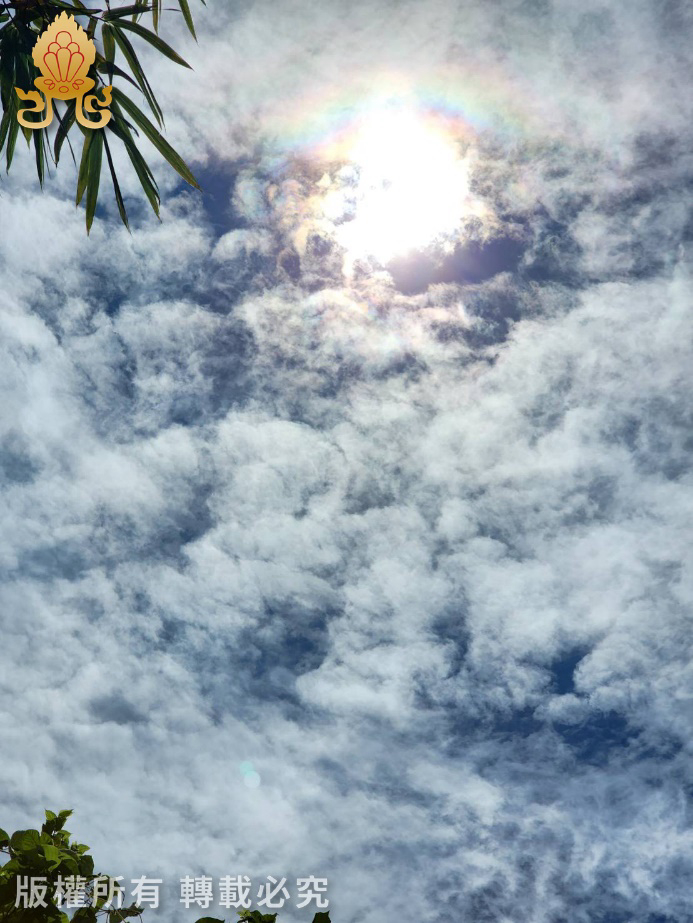
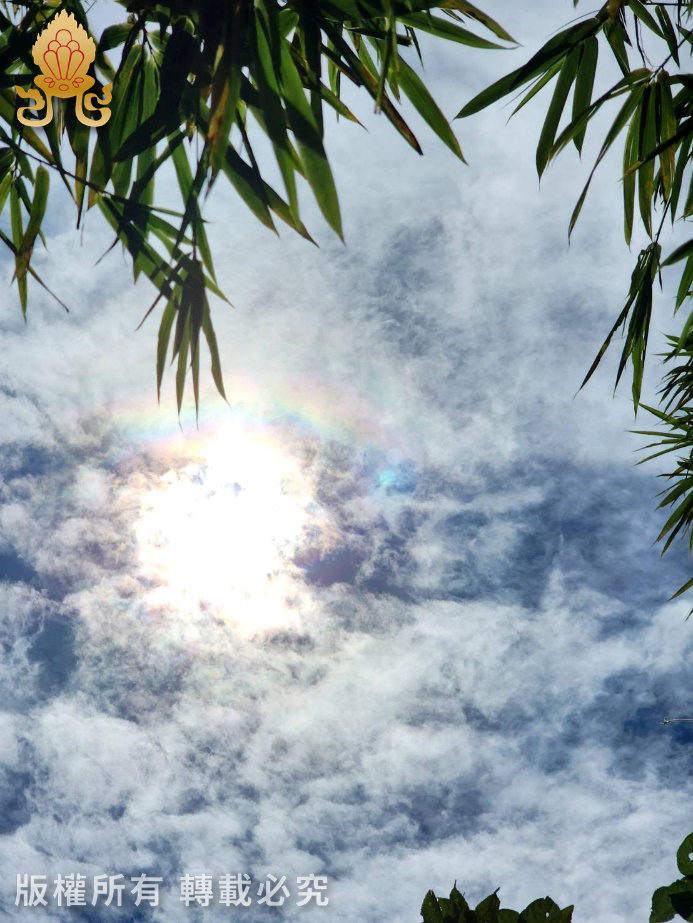
Upon the perfect completion of the puja, an incomparably wondrous sign of colorful clouds appeared in the clear sky: It looked as though Amitabha Buddha was sitting on his Lotus Seat with the seven-colored aureole behind him, coming to give blessings in person and receive the sentient beings, and surrounding him, one could also see Bodhisattvas from all directions. At this moment, a gentle drizzle of nectar rain fell from the sky, touching the body yet not soaking it. From the beginning of the puja until its perfect completion, a miraculous fragrance permeated throughout consistently and unceasingly, and anyone who smelt it felt clear and calmed in body and mind, and each rejoiced and gave praise. The various incomparably wondrous auspicious signs were akin to the Buddhas and Bodhisattvas coming in person to praise Rinpoche’s incomparably wondrous and perfect achievements in cultivation, as well as his immense compassion (maitrī and karuṇā)and merit for benefiting sentient beings.
« Previous - Puja Teachings - Next »
Updated on September 10, 2026