


His Eminence Rinchen Dorjee Rinpoche’s Puja Teachings – December 7, 2025

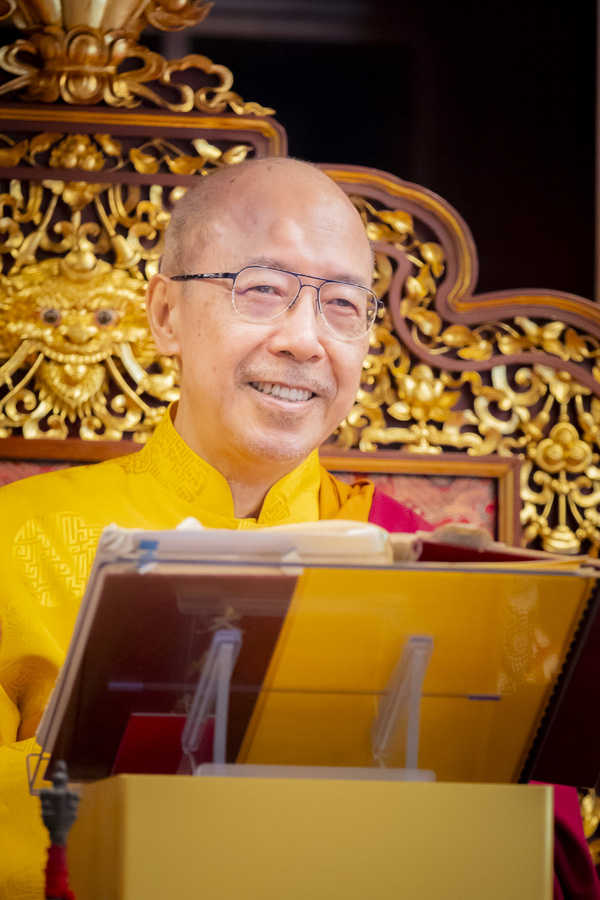
His Eminence Vajra Guru Rinche Dorjee Rinpoche ascended the Dharma throne and expounded on ‘Scroll 32, Chanding Paramita’(Chapter 10, section 2) of The Mahayana Sutra of the Bodhisattva Treasury of the True Dharma Taught by the Buddha, and Gongchig (dgongs gcig, The Single Intention) by Lord Jigten Sumgon.
Before I expound the Ratnakuta Sutra, I will first expound a paragraph from ‘Gongchig (dgongs gcig, The Single Intention), written by Lord Jigten Sumgon. One section is particularly crucial for Buddhist practitioners:
Although some people maintain—based on their understanding—that without accomplishing fate, all merits can still arise, we of the Drikung Kagyu lineage assert that if fates are not accomplished, no merits can arise at all. Regarding this point, certain virtuous friends hold that even without accomplishing fate, all merits can still be produced. Their analogy is as follows: it is like a person who has placed all treasures inside a dark room without windows. Because it is too dark, the existence of the treasures cannot be seen. Once this person arrives holding a lamp, all the treasures become clearly visible, one by one. Similarly, at the Casual Ground, sentient beings already possess all the merits of the Buddha—that is, our pure nature is identical to that of the Buddha. However, due to the obscurations of afflictions, karmic forces, and ignorance, these merits remain unseen. Once one realizes the Mahamudra Dharmakaya, which is like a lamp, all merits arise spontaneously and effortlessly, without the need to accomplish their fates. In response to this view, Jigten Sumgon stated that if fates are not accomplished, nothing whatsoever can arise. That is to say, if no virtuous fates are created, none of the merits will come into being.
In the Sutra of Individual Liberation, Shakyamuni Buddha taught that all Dharma arises from fates, and the Buddha explained these as fates. How, then, are fates extinguished? The Great Śramaṇa said, ‘Commit no negative acts, do all good deeds, and purify one’s mind—this is the teaching of all Buddhas.’All phenomena arise only when there are fates; Dharma refers to all the phenomena that you see and hear. The Buddha taught how to extinguish these fates. The Great Śramaṇa said—this is what Shakyamuni Buddha taught, ‘Commit no negative acts, do all good deeds, and purify one’s mind—this is the teaching of all Buddhas.’ Here, it is explained not only that the fate of suffering is evil and that evil should be abandoned, and that the fate of happiness is virtue and that virtue should be practiced; it is also explained that the karmic fate of body, speech, and mind arises from mental action. That is, when no thoughts arise, the karmic causes of body, speech, and mind do not come into being. Therefore, one should subdue and purify the afflictions of the mind—this very cause. The method for extinguishing causes is the first and primary key practice for Buddhists, and it is also the supreme and distinctive Dharma of Buddhism. This means that other religions do not possess this method; it is unique to Buddhism, an unsurpassed and exceptional teaching.
How to (practice) ‘Commit no negative acts, do all good deeds, and purify one’s mind—this is the teaching of all Buddhas?’ Every Buddhist sutra states such, but you all haven’t accomplished it; don’t think yourself a Buddhist. Because you still commit all the evils, the thoughts will not be pure; naturally, the fate of the body, speech, and mind is not fated with pure virtues, it must be the fate of evil. This method of elimination of fate states very clearly that only us Buddhists have it. Same, generally speaking, not only does one have the capability of the Great Mudra, which can know the nature of the heart. Great Mudra is the Mahamudra. The arising of merits in Bodhisattvas who have reached the Pure Stages is likewise dependent on this principle; even the merits of the Buddha Bhagavad in body, speech, and mind do not arise unless fates are properly accomplished. This means that without actual practice—relying solely on the protection or blessings of the guru—it is impossible to eliminate unvirtuous fates, and it is equally impossible for merit to arise.
Just as yesterday, there was a father and son who came to seek an audience. As soon as they knelt down, I could see that something had happened to the son’s hand—it was injured in a bicycle accident. I said, ‘The amount of time you spend approaching the Buddha Dharma each day definitely does not exceed ten minutes.’Therefore, he has no virtuous fate. However, because he is my disciple who has taken refuge, he was protected once—but there will absolutely not be a second time. The father, too, failed to supervise his son. He assumed that as long as his son passed his exams, it was due to the blessings of the Buddhas and Bodhisattvas and Rinpoche’s protection, yet his offering was only a small stack. Setting aside the offering, he clearly knew that his son’s injury meant there were unpurified negative karmic causes, yet he still made a casual offering, hoping that Rinpoche would bless him so that he would not encounter further misfortune in the future. That is impossible—because there are no virtuous causes. Why am I speaking about this in particular today? Because I just happened to open the text at random, and all of you are not planting virtuous causes at all.
Yesterday, there was also a disciple who brought a pair of children to plead for the Dharma texts. From an ordinary perspective, when young disciples plead for the Dharma texts with the aspiration to learn Buddhism, one would think they should be given them! But Rinpoche is truly incredible; these disciples had taken refuge for more than ten years and had never implored for any Dharma texts; suddenly, they wanted to plead for several, there must have been a cause behind this. That cause came from a talkative monastic, who set himself up as if he were Rinpoche and suggested which Dharma texts they should implore. He could have told them that they had not been practicing diligently and that they needed to be cautious and obedient, but he did not. Why did I not give Dharma texts to these two children? The talkativeness of this monastic was one cause. The second cause was that this mother had once offered me a piece of jade. I placed it in the shop, and every time she came to the shop, she would say that this was the jade she had offered. When the mother didn’t notice it, the daughter would tell her that her jade was placed over there. Tell me—does this count as a genuine offering? Later, I returned the jade to her, yet she did not come to repent. This shows that no virtuous fate had been created. Today, Rinpoche is not intentionally scolding anyone. Everything I say has its basis, I simply opened the text at random just now and spoke this passage to you.
Before the puja, a disciple took out a chain—no one even knew who had offered it—and showed it to everyone. It had been worn until it was blackened, clearly for decades. At the very least, it should have been cleaned. Does this count as an offering? This is not an offering, yet the person believed it was. Other centers might think this is acceptable. With gold prices so high these days, a gold chain is worth at least one or two thousand dollars—but I do not want it. Why? Offering something so filthy to the guru brings extremely frightening karmic consequences. I refuse it and return it to the person so that those consequences are eliminated. Do not throw garbage at me anymore.
Recently, there was a group of people who were said to be practicing very well. The jewellery shop called them and hoped they would come to see the jewels; they all said that now they were learning Buddhism, and they didn’t need these. I suddenly discovered that I have so many disciples who practice Hinayana! Let me ask everyone, does Bodhisattva Avalokiteshvara wear jewels on the body? (The assembly replies: Yes.) What are we practicing? We practice the Bodhisattva path. Because learning Buddhism doesn’t need these things; these words spoken from their mouth are as if even opening a jewellery store is a crime. Does it state in the Ratnakuta Sutra? ( The assembly replies: No.) Don’t want to buy, or no money to buy, one could speak directly; one can also say that one wants to keep the money to make an offering to Rinpoche. But why does one need to take the Buddha Dharma as a defense? Feeling very proud of yourself, and believing their practice is going very well, and now, there’s no need for these materials. People who have spoken such types of words, I hope you deeply repent, because it is making false speech! If there is truly no need for materials, then learn what I did at Lapchi Snow Mountain, plain water cooked plain noodles; If you start tonight and spend a month eating plain noodles cooked in plain water, then you truly won’t need material things. The meaning of making false speech is that one claims one has done it, but hasn’t. Because you learn Buddhism, so no need for material things; the meaning is that one even scolds Boddhisattvas. The Universal Gate Chapter states very clearly what Bodhisattva Aksayamati gives to Bodhisattva Avolokiteshvara. (The assembly replies: Yingluo.) Yingluo is jewelry. Bodhisattva Avolokiteshvara even makes a portion of it as an offering to Shakyamuni Buddha as well. Then Shakyamuni Buddha shouldn’t have taken the jewelry, right? Please, you guys, if you don’t practice, don’t use Buddhist terms to cover up worldly matters; this is a very heavy crime. If you don’t want to buy, nobody will hit you; don’t be afraid of losing your face. Because one has no money and fears losing face later, they use the Dharma to push back.
Last week, the Dongfeng shop was extremely crowded. A disciple brought his daughter-in-law and grandchild and sat there for over one, even nearly two hours. After he finished eating, I asked a staff member to politely speak with him and ask whether he might give up his seat so that we could continue doing business. Don’t even think of me as Rinpoche—as a familiar customer, when my business is very good, I politely ask you to give up a seat so that I can serve other customers, will you? (The assembly replies: Yes.) Yet he actually went to the Dazhi shop to file a complaint, saying that we had driven him away. I ask that this person not come to my coffee shop again, and not bring his grandchild there to eat, as I am not lacking his business. Since you went to my Dazhi shop to complain, I am now formally accepting your complaint: do not go there anymore either. Because when we are full, we will certainly ask even my own disciples to give up their seats. Is this reasonable? (The assembly replies: Yes.) Now the Dongfeng shop has many outside customers who feel that The Glorious Jewel Coffee Shop offers very good food. I have said many times that whenever people praise The Glorious Jewel, it plants good fortune. Why, then, would this harmful disciple, for the sake of himself and his family, go and complain—without even daring to come and speak to me directly—thinking that I would not know? What is the point of my being Rinpoche then? I treat everyone as old friends, you come to my shop regularly, and when business is good, I politely ask you to give up a seat so that I can do more business. Anyone with genuine feelings would do so! The staff at both the Dongfeng and Dazhi shops know exactly whom I am referring to. From now on, do not do business with this person. If he insists on entering, do not even serve him as a disciple. This is acting in all unvirtuous ways and not cultivating virtuous ones at all.
Don’t think that you are practicing. From this little place, I can tell that you have not practiced. The job of the guru is to scold you on such matters. Thinking that reciting for 1,000 or 10,000 times every day, if the heart doesn’t change, the mantras recited are not the Great Six-Syllable Mantra of Bodhisattva Avolokiteshvara, but the Great Six-Syllable Mantra recited by the sentient beings in Hell. Because the heart is malicious! Going to the Dazhi store to complain about the Dongfeng store, are you trying to let the colleagues argue with each other? If you are so capable, go to the Dongfeng store to scold, and yet, you aren’t dare to do so. Don’t assume that running a restaurant is profitable; with ingredients of such good quality, there’s really no money to be made. Because I have many disciples who need to attend the puja on Sunday, working outside would prevent them from attending the puja.
If one wants to learn Buddhism, please remember these several sentences spoken by Jigten Sumgon; stop using the way of humans to learn anymore. That monastic disciple, why did he become such a busybody? He believed that he was eloquent; once he spoke and people listened, he had already accumulated merits. Every disciple present here, if anyone without any matters chats with this monastic disciple, both the disciple who chats and this monastic disciple will be asked to leave. Because he is a monastic without any qualification to speak with any female disciples. If any female disciple chats with him, I will ask you to leave. Rinpoche said to this monastic disciple: If you chat with any disciple again, I will kick you out, no matter what you said. Haven’t you eaten? Haven’t you recited the Buddha’s name? I will kick you out! All of the male and female monastics, help me to check on him. If he talks to others, and none of you reports to me, all of you will be kicked out. I’ve never seen a man so talkative; already ordained, yet still talking so much. Look at the disciple who has been ordained for over thirty years, does he chat with people all day?
Likewise, generally speaking, not only does one have the capability of Great Mudra which is the Mahamudra to know the nature of the heart. Therefore, we, among The Four Extraordinary Foundations of Vajrayana Ngondro, the last one is the guru will transmit the Mahamudra. But based on your quality, I am not able to transmit the Mahamudra. The merits of Bodhisattvas who have ascended to the ground of pureness are the same in this regard. That is to say, those who can realize the Pure Stages—Bodhisattvas from the First Ground onward—their merits likewise arise from virtuous fate. Even the merits of the Buddha Bhagavad in body, speech, and mind are entirely dependent on the fulfillment of fate. If the fate is not properly accomplished, merit does not arise. In other words, this applies to all beings, including the Buddha himself: if the virtuous fate for the virtues of body, speech, and mind is not fulfilled, then no merit will come into being.
Therefore, we must be very mindful of our speech. Do not assume that once something is said, it will be just fine. Just like that group who claimed that because they are learning Buddhism, they buy no jewelry; is such a claim correct? It would be correct if you were practicing the Hinayana. Those who practice the Hinayana do not even cook. But in order to save money, you all go home and cook. One who practices the Hinayana doesn’t even use lotion for the face, because one considers it troublesome. You aren’t practicing Hynayana now, and I have expounded so many times that lay practitioners can only practice the Bodhisattvayana, and there are no other methods to practice. You don’t listen. Instead, you hear something through the grapevine: Learning Buddhism needs to be pure, attach nothing, and want nothing. I have never spoken this, and neither have the Buddhist sutras. Why did you go astray from the path like this? The monastics may practice like this, but lay practitioners cannot. Because when you possess such type of thoughts, then you head to practicing Hinayana; and yet, you didn’t manifest the appearance of an ordained. Then what are you practicing? Shakyamuni Buddha expounds the Bodhisattvayana because there are more lay practitioners than monastics, so he opened this vehicle for you to practice. Then, be like a lay practitioner.
Live normally, but the heart is different, had I not told you? (The assembly replies: Yes.) Then, when you had no money to buy jewelry, why didn’t you just say honestly, that you don’t have the money now, but you’ll come take a look when you do have the funds?. Others would not berate you, and yet you chose to speak falsely about being a Buddhist and not seeking materialism. Do not break precepts without even knowing yourselves.
It is said in the Buddhist sutras that the gathering of light emerged in the Ratnakuta Sutra: I have various marvelous occurrences caused by virtuous karma and fate power, to break with various ignorances completely, and attain all kinds of light. This light is the light of wisdom, which means I have various types of virtuous karmas, and marvelous does not mean one does not understand the matter, but that it does not need to be contemplated or discussed, one naturally acts upon such virtue. Caused by virtuous karma and fate power, one is then able to break free of the various ignorances. None of you listen, so you all cultivate without wisdom, and the more you practice, the more foolish you become, to the extent that I cannot even explain why there are such foolish people.
To generate all kinds of light means many different kinds of wisdom; for instance, a young person came to plead for the Dharma texts, and as a guru, one should be joyous that the youth is willing to learn Buddhism, but if I had no wisdom I would have been deceived and would not be able to dig out the fact that the male monastic was pretending to be the guru. His behaviour would not be scolded out there, in that one may think that he is helping sentient beings form virtuous fate, and since sentient beings do not understand, one tells them. However, here comes the key point, he is not the guru and therefore has no right to teach the Buddha Dharma. Second, he does not even understand the liturgy, how can he tell others which sutra to recite? Third, how does he know that it is suitable for this person to recite this Dharma text? This is ‘arrogance,’ by thinking that one is a monastic, one must help the layman form virtuous fate. He could have said to him, ‘You should quickly plead Rinpoche for the Dharma, you cannot be like this.’ But instead, he chose to be the expert by telling the other person to plead for the Thirty-Seven Practices of Bodhisattvas. Many who learn Buddhism are just like him, and therefore cannot sow any virtuous causes, and naturally will not yield any virtuous karma, and of course cannot break free from the various types of ignorance, which makes it impossible to develop any wisdom.
Bless that I may possess a bright light, by the name of the clear and pure sight, which comes from making offerings to Buddha by lighting a lantern, and from that generates this bright light. The so-called clear and pure sight is not the naked eye, but the sight of wisdom and the sight of the Dharma. If I didn’t possess the slightest bit of the sight of wisdom, I would have been deceived by the person who came to seek an audience yesterday, and would not have been able to see so many problems. You would have absolutely not been able to see that there was such a capable male-monastic disciple behind all this, doing things quietly without my knowing. A youth who had taken refuge under me for a decade or two would not listen to anything I say, but would listen to the single sentence spoken by a male-monastic? In fact, he was not really listening to him, but instead, it was Dharma Protector Achi exposing the two of them so I could know, not for my own benefit but because it is not good for them, and it was out of the hope that they would not continue to behave this way, to help them.
By no means do I enjoy scolding people, but this is what the Buddhist sutras instruct me to do. For instance, the clear and pure sight, which comes from making offerings to Buddha by lighting a lantern; many believe that it is lighting a lantern for Buddha, but no, the real lantern is to make an offering to Buddha with your light of wisdom, and thereby your light of wisdom becomes in touch with that of Buddha, and that is a real offering. How to emit this light was already explained earlier, and if you don’t act upon it, how can you make an offering to Buddha?
The Prajanaparamita Sutra also states that before the perfection of the two samyak (correct) wisdoms, one cannot reach enlightenment of the samyak Śūnyatā (Puja Teachings Index 21), and as mentioned above, karma and fate are also the treasures of Buddha’s teachings. Before the perfection of the two samyak (correct) wisdoms means that before the perfect completion of good fortune and merit, one cannot reach enlightenment of the samyak Śūnyatā (Puja Teachings Index 21). The samyak Śūnyatā (Puja Teachings Index 21) as mentioned, is not stubborn Śūnyatā (Puja Teachings Index 21), or the thought that there is nothing. When one reaches enlightenment, that is the perfection of the two resources. Therefore, why is one berated for making an offering with a golden chain that has been so tainted black? Because making offerings this way will never enable one to reach perfect completion, and without perfect completion, it is impossible for one to reach enlightenment about the samyak Śūnyatā (Puja Teachings Index 21). You may say that you don’t need to reach enlightenment about the samyak Śūnyatā (Puja Teachings Index 21), simply not falling into the Three Evil Realms would suffice, but the problem is, in the moment of your final breath, if you have no sense of Śūnyatā (Puja Teachings Index 21) at all, you will drift along with the tide and follow samsara, also, if you don’t believe in or disrespect the guru, the same will happen.
Karma and the generation of fate are important treasures taught by the Buddha. Therefore, in practicing Dharma, learning Buddhism, and everything, karma is very important and so is the generation of fate. For instance, this male-monastic disciple takes pleasure in speaking casually, so the generation of fate is bad. We need to retreat and prohibit speech because speaking too much is not good for oneself, how so? I don’t believe that every sentence you speak refrains from going against karma. Therefore, the monastics must speak sparingly, yet he loves to talk, just like a parrot, seeking this one and that one out all day; this includes all male disciples , if any one of you say a word to this male-monastic disciple, you will have to go. Because his livelihood is my responsibility, and none of your business; those of you who agree with his viewpoint can leave. This passage states very clearly that if the fate of learning and practicing Buddhism and practicing unvirtuous, no matter how many times you recite the mantras or perform grand prostrations, all will be useless. How can we enable our causes to be virtuous? We must listen to the methods stated in the sutras and taught by the guru to change our hearts.
‘Scroll 32, Chanding Paramita’(Chapter 10, section 2) of The Mahayana Sutra of the Bodhisattva Treasury of the True Dharma Taught by the Buddha.
Sutra: ‘Sariputra. Further, what is the Bodhisattva Mahasattva’s supernatural power? Further, what is wisdom? To view forms and aggregates correctly (samyak) with one’s divine sight. This is what we call supernatural power. ’
The key point in this passage taught by Shakyamuni Buddha is the fear that those who learn Buddhism become superstitious about supernatural powers, and turn non-Buddhist supernatural powers into that of the Buddha Dharma. In fact, all of these supernatural powers are only accomplished by Dharmakaya Bodhisattvas (those beyond the Eighth Ground Bodhisattvas), but due to the fact that it is the Era of Dharma Decline, many people claim to practice Vajrayana, to learn Buddhism, and have supernatural powers, when actually many of these are supernatural powers through ghosts, or heretics, completely unrelated to the supernatural powers of Buddha Dharma. Thus, Buddha makes a point of mentioning this so that you can tell which ones are the supernatural powers of the Bodhisattvas.
The Bodhisattvas view forms and aggregates correctly (samyak) with one’s divine sight, the viewing correctly (samyak) mentioned here means that when the Bodhisattva views any phenomena, it is not through connectivity, feelings, curiosity, or simply to show that one possesses supernatural powers. Correctly (samyak) means that when one views these forms and aggregates, it is not out of curiosity but out of the hope or need to use this method to benefit sentient beings, or further resolve their particular problems. The hereby mentioned viewing correctly (samyak) is not for one’s own benefit (including fame, honor, or any offerings), but rather to employ Buddha Dharma, karma, and fate to view these forms and aggregates, which are the outward appearances.
To give a most obvious and simple example, this mother who brought her two children to implore for the Dharma texts yesterday—if I did not possess the slightest bit of divine sight, and I did not view them correctly, I would have been deceived by them and gave them Dharma texts, and later they would have thanked that male-monastic, and he would help them with how to recite, and thus would have begun a malicious cycle. Therefore, the divine sight may not see anything in particular, but rather with the divine sight, one can perceive with what kind of heart does this person implore the Buddhas and Bodhisattvas, and through viewing correctly one sees his reason for pleading for the Dharma. Bodhisattvas do not judge whether there would be any benefits for themselves if someone implores and receives the Dharma, or whether there will be any downfalls if he does. If one comes to plead for the Dharma, before the Bodhisattvas grant him, they must perceive distinctly, where does the heart behind his implorement of the Dharma reside? For instance, a disciple came to plead for the Dharma; he said he wanted to plead for the Vajrasattva, and I said he performed the grand prostrations very slowly, and he replied that his heart was in a poor condition. After he spoke this sentence, I understood that I would not transmit the rest of the Four Extraordinary Foundations of Vajrayana Ngondro because he came to plead for the Four Extraordinary Foundations of Vajrayana Ngondro only for his heart condition.
So you say I shouldn’t speak, but even not speaking isn’t acceptable (the assembly laughs), but still I would know, so your Rinpoche is not that easily deceived. If you come to plead for the Dharma devoid of the correct mindset, there’s definitely going to be some kind of situation; having taken refuge for over a decade, and raised children old enough to come plead for the Dharma, yet only to create all this drama. Yesterday, had there been a slight lapse in my concentration, I would have allowed them to get what they came seeking for. And even if he did get the Dharma text, he would not recite it because I did not transmit the Dharma, instead it was someone else who told him to get it, and if he did take it, he would say ‘Ah, Rinpoche, I will take this with me.’ Would he recite it? ‘Sure.’One learns Buddhism with deception. Therefore, the meaning of this sentence means that the real Bodhisattva Mahasattva perceives all matters with the correct view, this is what we call supernatural power; only then is it supernatural power. If someone tells you that he sees something, from Buddha’s point of view, this is not a supernatural power, but merely perceiving a phenomenon instead of perceiving forms and aggregates through the correct view. To perceive forms and aggregates through the correct view is to see what the other person’s problems are, and help the latter resolve those problems. To not degenerate, act wrongly, break precepts, or make mistakes, such is what Buddha calls supernatural powers, instead of being able to see certain things. Therefore, you may by channeling encounter others who say ‘I see that your guru is such and such;’you should listen but not take them seriously because he has no criteria to view me this way. Do not think that he is truly capable, once you have that thought, you will be snatched.
Sutra ‘The illusory Dharma wisdom is not correct action. This is nominal wisdom.’
The illusory Dharma wisdom is not helping the sentient beings correctly; if a Bodhisattva does not help sentient beings with Buddha’s wisdom and Śūnyatā (Puja Teachings Index 21). Illusionary Dharma, means that it is unrealistic, illusive, changing wisdom. It is not correct action—this is not helping sentient beings through correct action. This is nominal wisdom. Since illusory wisdom is not helping sentient beings through correct actions, why is it called wisdom ? Because wisdoms are differentiated into many different levels; for instance in the Single Intention, there is quasi-wisdom(Anvayajnana,)that which is similar to wisdom but which is not fundamental wisdom (Jnana-sattva)nor acquired wisdom (Aparajnana), but rather it is wisdom attained through cultivation, which is the kind of wisdom equivalent to you having studied a great amount will know more things than others, but which is not natural wisdom that is developed from the heart through learning Buddhism.
What is fundamental wisdom (Jnana-sattva)? Every person, every sentient being, possesses the same clear and pure fundamental wisdom, exactly the same as Buddha. In Single Intention, it says that because we have committed many virtuous and evil karmas, which have eclipsed our wisdom, we cannot see it. Through practicing, one enables acquired wisdom (Aparajnana), which is the wisdom cultivated through Buddha Dharma, turn the key to our fundamental wisdom (Jnana-sattva), and when the acquired wisdom (Aparajnana) is joined with the fundamental wisdom (Jnana-sattva), it is a kind of clear and pure wisdom. If you do not practice today, you will never possess the acquired wisdom (Aparajnana), but merely a small amount of human and heavenly good fortune. Today, since you have taken refuge, learned Buddhism, have listened, and thought‘I know—’ but none of this is wisdom. Just like the father who brought his son yesterday, if I had no wisdom, I would have been blinded by them, and felt pity for them for getting bumped into, or I would have said, ‘Be careful when riding the motorcycle, Avalokiteshvara Bodhisattva protects you, perhaps your father prostrates very well.’ Some people think that monastics should speak like this, which shows compassion. However, Rinpoche does not say such things; a single sentence pointed out that he never came in touch with Buddha Dharma for over ten minutes a day. If I did not have this power, I would have been deceived by him again, and indulged him in continuing his complacency and avoidance to learn Buddhism.
As I have said when you took refuge: when one refrains from practicing the Dharma that was transmitted, it is complacency, and if one is complacent, one cannot receive the blessings of the guru, and many things like such have occurred. Do not think that everything will be fine having attended the pujas, one is merely better off than those who do not attend, but if you want to turn the karma committed in the accumulated past lives around, it cannot be achieved without cultivation; don’t think that you can also just rely on me. I can protect you once, but do not think that I must always protect you. When you face danger and disasters, Rinpoche can practice the Dharma for you to pause the danger and disaster, so that you may practice diligently, but if you are always so dependent on me, I will stop doing this. Therefore, why is there only one puja, and not until February? Because everyone is unwilling to take refuge and reluctant to learn Buddhism, so why should I practice so many Dharmas? It creates thoughts of greed in you. Why do I practice Dharma in February? Because next year is not going to be a good year, I hope that my refuge disciples, and those sentient beings who have made donations to the Monastery can make it through the next year, but be clear, to be able to ‘make it though.’ Do not think that reciting 1000 or 2000 times each day means that you are practicing, if you do not change your character from the root, and instead learn Buddhism in the way that an average person conducts oneself, there is no way for you to attain achievement.
This is a big challenge. But you have to do it! I don’t know whether you are fortunate or unfortunate to have taken refuge in a guru who has some small supernatural power. This supernatral power is not about seeing whether there is a ghost behind you, or a dog following you, or anything like that; nor is it about seeing whether your future prince Charming will come from the East or the West (The assembly laughs). That is not what I see. What I see is whether your attitude toward learning Buddhism is correct. When you kneel before me, is your mind right or not? If it is, I transmit the Dharma; if it is not, I do not. That is my supernatural power. Not transmitting is to make you be mindful of your own mind, letting you know that you have not been learning the Dharma properly.
Sutra: ‘Furthermore, Sariputra, if, with regards to all sentient beings, there is genuine hearing, the teaching is called supernatural power.’
He further tells Sariputra that ‘If, with regards to all sentient beings, there is genuine hearing.’Genuine here means that when the Bodhisattva expounds the Dharma, all beings in the Six Realms can hear it. Only this kind of teaching is called supernatural power. How to put this into practice? For example, when I perform the Chod, sentient beings will come. This is because all sentient beings genuinely hear the compassionate Brahma sound and know to come to receive consciousness-transference. If there were no supernatural power, they would not come. When everyone participates in a Chod Puja, a Great Amitabha Puja, or when I chant mantras or blow this horn, you will absolutely feel very cold. If heard by human ears, the sound of this horn can at most be heard just outside the window; beyond that, it cannot be heard. So how do sentient beings hear it? It is through the guru’s supernatural power that the sound reaches everywhere without limit. As long as there is a fate, those who hear it will come; otherwise, how could it become so cold? The coldness is because once one loses a human body, the fire element is gone, and naturally it becomes cold. If they had not genuinely heard the compassionate call, they would not come. Even if one appeared to them as a Bodhisattva, they would still take it to be an illusion and would not come. Only when they hear the compassionate call will they come.
Fortunately, Rinpoche does many different kinds of things, so I can use them as analogies for you to understand; otherwise, when you encounter this sentence, you would not know how to explain it at all. The Chod is the most obvious example—once it is performed, they come immediately. Of course, when the guru has cultivated compassion of Śūnyatā (Puja Teachings Index 21) and already possesses bodhicitta, those sentient beings truly hear the guru’s call and therefore come. Likewise, when the guru chants mantras, they hear them and come; otherwise, they would not come. Do you think a guru can physically become as vast as the void? That is absolutely impossible. So why must one attain authentic Śūnyatā (Puja Teachings Index 21)? Because only by attaining authentic Śūnyatā (Puja Teachings Index 21) can one be free from all attachments. Then the mind becomes boundlessly vast—the mind becomes as vast as the void itself. Thus, whenever any sentient being within the void needs the help of the Buddha Dharma, the guru will sense it, and he will be there.
Have you all already bewildered? Are you bewildered or not? (A monastic disciple replied: No.) You’ve never heard this before, have you? (A monastic disciple replied: No.) Then explain why you’ve never heard it. (A monastic disciple replied: Because in the past we never encountered someone like Rinpoche, so we never heard this.) Don’t flatter me. (The assembly laughs.) Let the disciple who has been ordained for more than thirty years speak. (The disciple who has been ordained for more than thirty years replies: Only someone who truly practices and truly realizes, like Rinpoche, and who has cultivated to the level of the Dharmakāya (Dharma-body), can do this. People like us cannot.) That is because if one has not attained enlightenment and has not realized Śūnyatā (Puja Teachings Index 21), the Buddha’s words remain merely as text. Using words to explain the state of Bodhisattvas and Buddhas is impossible because human language cannot describe the state of Bodhisattvas and Buddhas. Therefore, the Buddha said, ‘The Buddha says what cannot be spoken,’ it does not mean that the Buddha says that it is not allowed to be spoken, but that it cannot be expressed. Human language is limited and can never fully explain the state of Buddhas. This is what the Buddha meant by saying, ‘Like a person drinking water, only they know for themselves whether it is cold or warm.’ Only the one who drinks knows how cold or how warm it is; others do not. Only when it reaches your mouth do you know how icy or how warm it is—those beside you do not know, nor do your parents or your children. Only you yourself know. The Buddha Dharma is like this.
Therefore, the supernatural powers cultivated by the Buddhas and Bodhisattvas are not for demonstrating superiority over others, nor for displaying power to compel people. Their supernatural powers are used to help sentient beings. Only when sentient beings can perceive this supernatural power will they accept the help from the Buddhas and Bodhisattvas. Otherwise, how could the Buddhas and Bodhisattvas call them forth? Because the exoteric Buddhist sutras neither teach nor explain these. Why did Śhakyamuni Buddha neither teach nor explain them? Because there is no way to teach or explain them before achieving that level of realization. However, since you have seen many examples here with me—for instance, when I practice The Chod, you feel cold, and once I explain it, you understand. If this were explained to people outside, they would not understand, because they have no such experience or sensation and have not undergone such Dharma. No matter how it is explained, they cannot absorb the essence of the sutras.
Why didn’t the Buddha explain these things clearly? The Ratnakuta Sutra was originally taught for those who practice the Bodhisattva Path. Therefore, those who claim they are learning Buddhism yet say they do not need so many material conditions are not practicing the Bodhisattva Path. Since they are not practicing the Bodhisattva Path, remaining at my Buddhist Center will be very difficult for them. The Bodhisattva Path means that everything is done for the benefit of sentient beings and that one must respect the guru in all things. Without a guru, it is impossible to cultivate to the level of fruition; therefore, one must be extremely careful and attentive in all matters concerning the guru. For example, when His Holiness was about to enter a three-year retreat, I had already prepared many things for him before he even left. Although he did not say anything, I could still make suggestions. Whether His Holiness accepted them or not did not matter; perhaps he did not need them. His Holiness entered retreat in July, and last month I still sent him a batch of soy milk, because he needed it.
You truly have not learned the Dharma and are still trapped in a dead end, merely praying for the Buddhas and Bodhisattvas to bless you. Do the sutras say that the Buddhas and Bodhisattvas bless those who generate the motivation to practice the Bodhisattva Path? Do they or do they not? (A disciple ordained for thirty years replies: Yes, they do.) Do the sutras say that when you generate the motivation to practice the Bodhisattva Path, all Buddhas and Bodhisattvas will protect you as something even more precious than parents cherish their children? Do they or do they not? (An ordained disciple replies: Yes, they do.) Then reflect on whether you are practicing the Bodhisattva Path. If even something as small as respectfully asking you to leave during a meal makes you harbor resentment, are you practicing the Bodhisattva Path? This is what the sutras teach. Therefore, everyone should question themselves. Another year is about to pass; do not continue to waste your time.
Sutra: ‘As for the faults of the past, they are all unobtainable. This teaching is called wisdom.’
When a Bodhisattva has possessed supernatural powers, past mistakes will not be repeated. Even if mistakes were made in the past, the Bodhisattva can teach sentient beings so that they do not make the same mistakes again; this is called wisdom. Many people hope that I will awaken their wisdom, but if that is what you want, then you must have done something wrong; otherwise, how can I awaken your wisdom? Therefore, you must first begin by correcting your own mistakes. For example, someone once made an offering of jade, yet afterward kept regretting it and feeling reluctant to part with it. Thus, all the merit is completely gone. After making an offering, if one still clings to it as their own possession, then I must correct that person. I returned it to her several months ago, but I did not say anything all the time, because it was not yet the right moment—if I had spoken then, she would have become angry. I waited until this chance, when she came to implore the Dharma for the sake of her children. She was extremely nervous and kept asking her son, ‘You say it!’ I told her three times, ‘Be quiet,’ yet she kept saying, which shows that this woman does not respect me. It is habitual for her. She only wants to stay here and receive blessings so that her whole family can live safely through this lifetime—that is also acceptable. But one must be obedient; if one does not listen, then what can be done?
Sutra: ‘Furthermore, Sariputra, if one fully knows all mental activities, this is called supernatural power. With the mind is extinguished while wisdom and correct conduct are not extinguished; this teaching is called wisdom.’
This sentence cannot be explained by ordinary people. The Buddha said to Sariputra, ‘If one fully knows all mental activities,’ meaning that he knows what all the thoughts and activities inside all sentient beings’minds. I demonstrated this to you repeatedly yesterday. This is knowing your mind and knowing what your actions will be—this is what is called supernatural power. If one possesses such supernatural power, then ‘with the mind is extinguished while wisdom and correct conduct are not extinguished.’ This means that Bodhisattvas use their mind, their correct wisdom, to eliminate your false wisdom, but do not eliminate your correct conduct. For example, those two people who came to implore the Dharma yesterday, just because they listened to what the monastic said, did not mean that they were no longer allowed to learn Buddhism with me. I scolded them, yes, but I did not drive them away. What does this mean? It means helping them eliminate their wrong wisdom while preserving their correct conduct of learning Buddhism. Do you understand? This is very difficult—removing something on one side while not removing it on the other side is extremely exhausting. I’m almost ready to retire.
Sutra: ‘Furthermore, Sariputra, with regard to thoughts of what comes before, there is no obstruction. This is called supernatural power.’
Thoughts of what comes before without obstruction does not mean before and after. Rather, it means that when a Bodhisattva is going to help sentient beings—when a sentient being gives rise to a thought wishing to receive help, even at the very moment of imploring—the Bodhisattva is able to know what kind of intention has arisen beforehand. Why is it necessary to know this? Because if the intention that arises is incorrect, obstacles will inevitably appear. Therefore, the Bodhisattva must help that person change their thoughts so that in the future, when they learn and practice Buddhism, there will be no obstacles. This is called supernatural power. From this perspective, all supernatural powers exist for the sake of sentient beings to practice cultivation and learn Buddhism; they are not for Bodhisattvas to gain fame, reputation, or material benefit, nor are they for having more disciples in the center. Propagate Buddha Dharma in this way, the number of disciples will only decrease, because those who are willing to learn the Bodhisattva Path and willing to truly practice the Bodhisattva Path are extremely few.
Although many people say that academic study is very important—and I also agree—because in society, if one has no academic achievement, relatives and friends will view one differently and say that practicing Buddhism has caused one’s studies to fail. However, the Sixth Patriarch Huineng was illiterate; Taiwan’s most renowned old monk Guang Qin was also illiterate; and the Venerable Milarepa was likewise illiterate. Those who were illiterate, on the contrary, cultivated very well, because whatever the guru said, they took it in completely. They did not go back to consult books again. Especially now, with the internet being so convenient, when Rinpoche says something, people immediately check whether other Rinpoches say the same thing, comparing one with another. As a result, cultivation does not succeed. Young people in particular are very prone to doing this: when they find that what Rinpoche teaches is something they themselves cannot accomplish, they look to see whether there is another way. In this way, they cannot continue practicing.
If in this life you lack a fate with a particular guru, you will not take refuge under that guru. Therefore, in the process and methods of practice of the guru, there must be some aspects that suit you. Yet you insist on thinking that you currently lack the ability to do them or that you dislike practicing in that way, and so you go seeking elsewhere. In that case, in this entire lifetime, you will never be able to learn even the slightest thing. Since the day I took refuge in His Holiness, I have had no curiosity at all—I do not go around listening here and looking there. Nowadays, there are many websites filled with so-called Buddha Dharma; I never read them, because they have nothing to do with me. That teacher is not my guru. No matter how well he speaks, that is his own matter—he has fates with other sentient beings, not with me. Why did I become His Holiness’s disciple? Because I have a fate with His Holiness. Since I have followed a guru with whom I have a fate with, do I still need to listen to others? I only listen to what is taught within the lineage. But you are not like this. You flip from one source to another, especially now, many university students like to do this—going to see whether others say the same thing. When they find that others do not say it that way, suspicion arises in their minds.
Sometimes your root-capacity does not reach the level to hear a certain kind of Dharma, so Rinpoche will not speak about it. When the fate is ripe, when your root-capacity is sufficient, and things are more or less ready, then I will mention it to you. For example, I now take out Jigten Sumgon’s Gongchig (dgongsgcig, The Same Intention), it is simply to let you be clear that the Dharma Rinpoche is teaching today was not invented by me. It already existed from the time of Jigten Sumgon. What I just expounded was also taught before; it was simply not explained in such detail. Yet you still do not believe it, because Rinpoche is not a Tibetan, not a reincarnate one, and is a lay practitioner. These are all excuses you use to distance yourselves from the guru. Aren’t you laypeople yourselves? As long as the guru suddenly becomes a bit more strict with you, you feel the guru is not compassionate. But how compassionate are you toward the guru? You even complain when going out for a meal. If the staff at the Dazhi Coffee Shop called the Dongfeng Coffee Shop to scold them for driving customers away, the two sides would start arguing. If you really had guts, you’d go to the Dongfeng Coffee Shop and scold those men—but you don’t, because the Dazhi Coffee Shop is staffed by women and the Dongfeng Coffee Shop by men. You’re really quite bad! Now, women are not easy to bully anymore! (The assembly laughs.) Try bullying these female disciples and see how they deal with you.
« Previous - Puja Teachings - Next »
Updated on December 11, 2025